Writing
Years 1- 6
Writing at Wilcombe
A whole school approach to writing is adopted, building on Drawing Club, which is used in Reception. Through using the scheme Literacy Tree, we immerse children in rich, engaging texts.
Carefully chosen books provide the foundation for:
-
Creative and purposeful writing
-
Strong vocabulary development
-
Clear progression in grammar and sentence structure
-
A genuine love of reading and storytelling
By exploring stories deeply, children learn how writers write — and begin to see themselves as writers too.
How Writing Is Taught
Writing lessons are thoughtfully sequenced so that children:
-
Explore characters, settings and themes through discussion and drama
-
Learn grammar and punctuation in meaningful contexts
-
Plan, draft, edit and improve their writing with confidence
-
Write for real audiences and purposes
Writing is not taught in isolation. Instead, children build skills naturally as part of a rich, engaging learning journey.
Why We Chose Literacy Tree
We chose Literacy Tree because it supports our commitment to high expectations, inclusion and creativity. The approach:
-
Engages all learners, including reluctant writers
-
Supports vocabulary and language development
-
Encourages independence and pride in written work
-
Builds strong links between reading, writing and oracy
Most importantly, it helps children enjoy writing — and believe they can succeed.
The Impact on Our Pupils
Through Literacy Tree, our pupils:
-
Write with increasing confidence and stamina
-
Use ambitious vocabulary and varied sentence structures
-
Develop a strong understanding of different text types
-
Take pride in their work and enjoy sharing it with others
By the time children leave our school, it is our ambition that all children are thoughtful, capable and enthusiastic writers, well prepared for the next stage of their learning.
Decision Spelling
Strengthening Spelling with Decision Spelling
At Wilcombe, we have introduced a programme called Decision Spelling to strengthen pupils’ spelling knowledge through a clear, consistent and sequential approach. The programme ensures spelling is explicitly taught, building logically from phonics knowledge to an understanding of word structure and meaning.
Previously, some pupils could recall spelling rules but struggled to apply them accurately in independent writing. Decision Spelling supports pupils to make informed spelling choices, helping them understand why a spelling is correct, not just what it is.
The programme aims to:
-
Secure strong links between phonics, reading and spelling
-
Improve spelling accuracy in independent and extended writing
-
Support pupils with SEND, dyslexia or weaker working memory
-
Ensure a consistent, whole-school approach to spelling
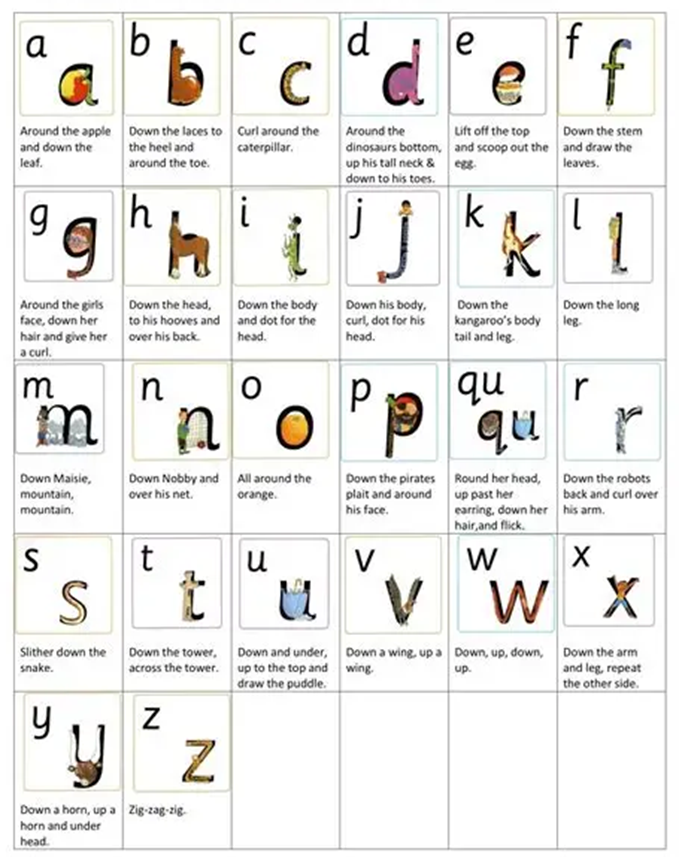
Letter formation
To introduce letter formation we use the following mnemonics linked to our Read Write Inc Phonics scheme, to support your child to practice early letter formation, please refer to the chart below: